

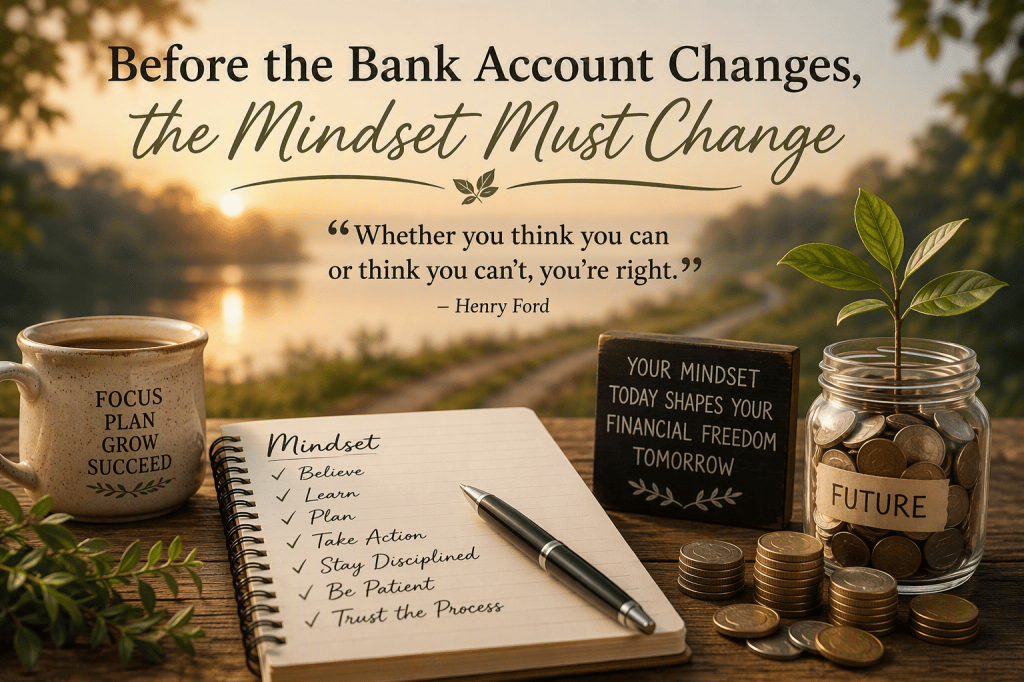
“Whether you think you can or think you can’t, you’re right.” — Henry Ford


By Michelle Allen
When people talk about financial success, the conversation usually centers on numbers.
Income.
Debt.
Investments.
Savings accounts.
Retirement plans.
All of those things matter, of course. But I’ve come to believe that long before financial success shows up in a bank account, it begins in the mind.
Our mindset shapes every financial decision we make.
If we constantly tell ourselves, “I’ll never get ahead,” we often stop looking for opportunities to improve our situation. We become discouraged before we even begin.
On the other hand, a person who believes, “I can learn, adapt, and improve,” is more likely to seek solutions instead of focusing on obstacles.
The difference isn’t always income.
Sometimes it’s perspective.
I’ve known people who earned impressive salaries yet lived paycheck to paycheck because they believed more money would solve every problem. I’ve also known people of modest means who built stable, comfortable lives because they learned to manage what they had and make intentional choices.
Financial success isn’t just about what comes into our lives.
It’s also about what stays.
One mindset shift that changed my own thinking was moving from scarcity to stewardship.
A scarcity mindset says:
“There will never be enough.”
A stewardship mindset says:
“How can I wisely manage what I have today?”
The first creates fear.
The second creates purpose.
When we focus solely on what we lack, we become trapped in a cycle of comparison and frustration. We look at someone else’s house, car, vacation, or retirement account and wonder why we aren’t where they are.
But comparison is expensive.
It can cost us our peace, our confidence, and sometimes our financial future.
Many people find themselves spending money they don’t have trying to match lives they don’t actually want.
A healthier mindset asks different questions:
- What are my goals?
- What matters most to me?
- What kind of life am I trying to build?
Those questions shift the focus from impressing others to creating a life that reflects our values.
Mindset also affects how we respond to setbacks.
Everyone experiences financial challenges. Unexpected expenses happen. Jobs change. Investments fluctuate. Life rarely follows the neat plan we imagine.
Some people see setbacks as proof they’ve failed.
Others view them as lessons.
The second perspective isn’t always easy, but it’s often more productive.
Every challenge teaches something about resilience, preparation, priorities, or patience.
Perhaps the most important financial lesson I’ve learned is that success isn’t measured by wealth alone.
True financial success is having enough to meet your needs, peace about your decisions, and the freedom to live according to your values.
For one person, that may mean early retirement.
For another, it means owning a small home outright.
For someone else, it means having the ability to help children, grandchildren, or a favorite charity.
Financial success looks different for everyone because our lives are different.
What matters is not whether your journey resembles someone else’s.
What matters is whether you’re moving forward.
A positive mindset won’t magically make money appear.
But it can help you develop the habits, discipline, and confidence that make financial growth possible.
In many ways, our mindset becomes the foundation on which everything else is built.
Because before we change our bank account, we often have to change how we think.
What financial mindset lesson has had the biggest impact on your life? I’d love to hear your thoughts in the comments.
#FinancialSuccess #MoneyMindset #PersonalGrowth #FinancialWisdom #LifeLessons #IntentionalLiving #FinancialFreedom #MindsetMatters #PersonalFinance #GrowthMindset #EchoesOfTheWillow


Leave a comment