


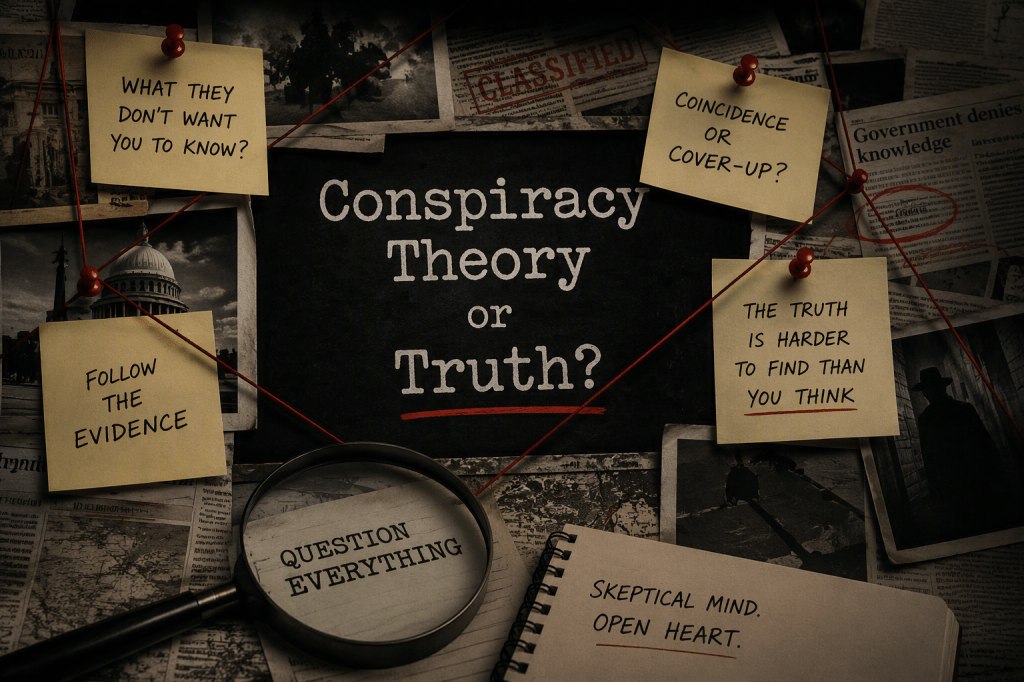
By Michelle Allen
Whenever someone asks this question, I get uncomfortable, not because I think every conspiracy theory is ridiculous, but because history has taught us that sometimes the unbelievable turns out to be true.
That’s what makes this question so difficult.
Most conspiracy theories fall apart when there’s no evidence behind them. They depend on assumptions, rumors, and the idea that thousands of people can keep a secret forever. In reality, the bigger the alleged conspiracy, the harder it is to hide.
But there is another category that fascinates me: claims that sound far-fetched at first, yet become more believable because similar things have happened before.
Instead of pointing to one specific conspiracy theory, I find the general idea believable that governments, corporations, and powerful organizations sometimes withhold information, mislead the public, or prioritize their own interests over transparency.
That isn’t really a conspiracy theory. It’s something we’ve repeatedly seen throughout history.
The challenge is that once people recognize that institutions are capable of deception, they sometimes swing too far in the other direction and start believing everything. Skepticism becomes cynicism. Healthy questioning becomes automatic distrust.
To me, the most believable “conspiracy theories” are usually the boring ones.
Not secret underground civilizations.
Not world-controlling cabals.
Not elaborate plots involving millions of people.
Instead, it’s the possibility that a company hid damaging information, a government agency kept embarrassing facts secret, or influential people used their power to protect themselves. Those scenarios require fewer assumptions and reflect behavior we’ve already seen in the real world.
The biggest lesson I’ve learned is that evidence matters more than plausibility.
A theory shouldn’t be judged by how shocking it is or how many people believe it. It should be judged by verifiable facts.
Ironically, the more a claim relies on “they don’t want you to know,” the less convincing it usually becomes. Real conspiracies tend to leave paperwork, whistleblowers, financial trails, and mistakes behind. They eventually become visible because humans are terrible at keeping secrets.
So if you ask me what’s a conspiracy theory I find believable, my answer is simple:
Not any particular theory.
I find it believable that people with power sometimes coordinate behind closed doors in ways the public doesn’t initially see. What I don’t find believable is that every major event in the world is secretly planned by a hidden group pulling all the strings.
The truth is usually less dramatic than the conspiracy theory, but often more complicated than the official story.
And that’s exactly why it’s so hard to tell the difference.
#ConspiracyTheory #CriticalThinking #TruthSeeking #QuestionEverything #Skepticism #FoodForThought #DeepThoughts #Perspective #WhatDoYouThink #ConversationStarter #BlogPost #WritingCommunity #CuriousMind #Discussion #OpenMind #EchoesOfTheWillow


Leave a Reply